
Understanding the Enneagram
History, Meaning, and Practical Applications
What is the Enneagram?
Don Riso has defined the Enneagram as "a geometric figure that delineates the nine basic personality types of human nature and their complex interrelationships." While the Enneagram suggests that there are nine basic personality types of human nature, there are, of course, many subtypes and variations within the nine fundamental categories. Nevertheless, the assertion of Enneagram theory is that these nine adequately map out the territory of "personality types."
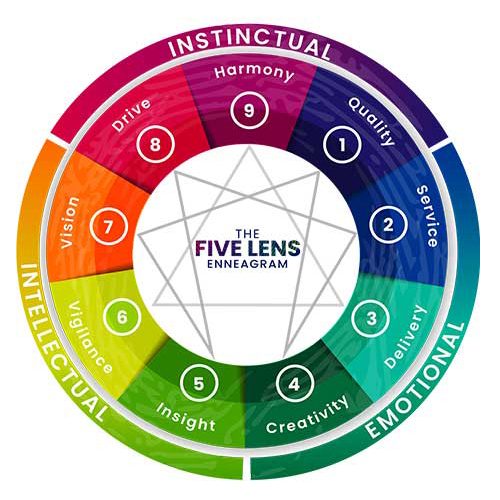
The Enneagram is also a symbol that maps out the ways in which the nine types are related to each other. This is the aspect of the Enneagram most people are familiar with because it offers them a framework for understanding themselves and everyone they deal with.
As a psychospiritual typology, the Enneagram helps people to recognize and understand an overall pattern in human behavior. External behaviors, underlying attitudes, one's characteristic sense of self, conscious and unconscious motivations, emotional reactions, defense mechanisms, object relations, what we pay attention to, our spiritual potentials and much more—are all parts of a complex pattern that forms each personality type.
Therapists, business counselors, human resource directors, and spiritual seekers from around the world are all finding the Enneagram to be immensely useful for self-understanding and personal growth.
Origins of the Enneagram
Where did the Enneagram come from?
The history and transmission of the Enneagram are mysterious and complicated affairs, although they become clearer if we distinguish between the Enneagram symbol and the descriptions of the nine types which are gaining such worldwide attention.
The symbol (the circle with the inner triangle and hexagon) is ancient, dating back to Pythagoras or even earlier. The concept of the nine personality types has elements rooted in several traditional teachings such as the Seven Deadly Sins (beginning in the 4th century), and the Kabbalah (beginning in the 12th century) but the psychological descriptions of the types, on the other hand, are modern and are the work of modern authors.
George Gurdjieff brought the symbol to the West around 1900, and Oscar Ichazo was the first to synthesize the symbol with elements of the teachings about the types. He was the first to identify the core qualities of each of the nine types, and his work was expanded on by the psychiatrist Claudio Naranjo who also introduced the panel method for gathering information about the types.
Naranjo's work, in turn, has been expanded on by Don Riso and Russ Hudson who added many new elements to the early Enneagram system—most notably the lengthy systematic descriptions of the nine types, as well as the nine internal Levels of Development, the "inner logic" of each type.
Practical Applications
What use is the Enneagram and how can it help me?
The Enneagram can be extremely useful to everyone as a source of self-knowledge because it acts as a kind of "mirror" to reveal features of our personality that normally are invisible to us.
Most of the time, people function habitually, as if on "automatic pilot," according to the pattern of their basic personality type. Usually this allows people to get along well enough in their lives, but when their normal routines break down or the stresses of their lives increase too much, their normal way of coping also tends to break down or become dysfunctional.
Seeing clearly what our habitual patterns are—seeing what we are doing and why we are doing it, and at what cost to ourselves and others—holds the key to our liberation.
By knowing your type correctly, you are able to see yourself—to "catch yourself in the act"—as you move throughout the day. With this increased self-awareness, you are also able to avoid reacting in negative and potentially dangerous ways.
Once real balance has been restored to the personality structure, the Enneagram can help us to orient ourselves to the higher spiritual and psychological qualities that each type has in abundance.
Living out of this realization shifts completely how we see ourselves, others, and the world, bringing liberation, freedom, and joy.
Historical Development
History of the Enneagram
A recently popularized typology which is moving into the mainstream in personal growth, therapy, spirituality, education and business arenas is the ENNEAGRAM (Any-a-gram). In Greek Ennea means nine and gram means point. The word refers to a circle inscribed by nine points which is used as a symbol to arrange and depict nine personality styles.
In its current formulations, the Enneagram brings together insights of perennial wisdom and findings of modern psychology. The Enneagram figure is derived from arithmology while the nine personality styles are validated by experiential observations.
The roots of the Enneagram are disputed. Some authors believe they have found variations of the Enneagram symbol in the sacred geometry of the Pythagorians who 4000 years ago were interested in the deeper meaning and significance of numbers.
This line of mystical mathematics was passed on through Plato, his disciple Plotinus, and subsequent neo-Platonists. Some believe this tradition found its way into esoteric Judaism through Philo, a Jewish neo-Platonist philosopher, where it later appears as the Tree of Life in the Cabalistic symbolism of ninefoldness.
Variations of this symbol also appear in Islamic Sufi traditions, perhaps arriving there through the Arabian philosopher al-Ghazzali. Around the fourteenth century the Naqshbandi Order of Sufism, variously known as the "Brotherhood of the Bees" (because they collected and stored knowledge) and the "Symbolists" (because they taught through symbols) is said to have preserved and passed on the Enneagram symbol.
Speculation has it the Enneagram found its way into esoteric Christianity through Pseudo-Dionysius (who was influenced by the neo-Platonists) and through the mystic Ramon Lull (who was influenced by his Islamic studies.) On the frontispiece of a textbook written in the seventeenth century by the Jesuit mathematician and student of arithmology Athanasius Kircher, an Enneagram-like figure appears.
More recently George Gurdjieff (1879-1949), a Russian teacher of esoteric knowledge and a contemporary of Freud, used the Enneagram to explain the laws involved in the creation and unfolding of all the aspects of the universe. He alludes to his introduction to the Enneagram in the 1920's during his visit to the Sufi Sarmouni monastery in Afghanistan.
In yet another culture and part of the globe, the Enneagram was taught by Oscar Ichazo (1976; 1982) as part of his Arica Training in South America. He found that the Enneagram (or Enneagon, as he calls the nine-sided figure) organizes comprehensively the various laws operating in the human person.
Claudio Naranjo (1990; 1994), a Chilean psychologist, learned the tradition from Oscar Ichazo and brought the Enneagram further into Western psychology by reframing its concepts in contemporary psychological language. Naranjo elaborated and codified Ichazo's explorations of the human personality still further.
In the early 1970's Robert Ochs, S.J. and Helen Palmer (1988; 1995) studied the Enneagram system of personality with Naranjo. Through Ochs the Enneagram was introduced to various Christian communities, where Jerome Wagner, Maria Beesing, Robert Nogosek, and Patrick O'Leary (1984), Don Riso (1987; 1990), Richard Rohr and Andreas Ebert (1990; 1992), Kathleen Hurley and Ted Donson (1991; 1993), Suzanne Zuercher (1992; 1993), et. al. became acquainted with it.
While the trail of the Enneagram grows less distinct before Ichazo, and the exact transmission of the symbol remains unclear, what becomes evident is that the parameters of the person as viewed through the lens of the Enneagram theory have been recognized in some fashion across ages and centuries and across cultures, races, and genders. The Enneagram taps into something universal in the nature and functioning of human beings.
Discover how Enneagram coaching works
or if you're ready, go ahead and take the assessment
Find out about Enneagram coachingTake the assessment